
 Industries
 Products
 Services
 Solutions
Blog | Setting the Standard: The Future of Flexible Grid Connection Studies
Power system operation throughout the world is in a period of significant change. While distributed energy resource (DER) penetration continues to grow, load - which has been relatively stable in most industrialized countries - has begun to shift dramatically. End uses formerly powered by fossil fuels (e.g., vehicles and home heating) are being replaced with electric alternatives, and data centers are drawing increasingly large amounts of power. The rapid changes have resulted in the pace of new elements outpacing the speed at which systems can accommodate these elements.
This has led applications for generation and load to come up against long wait times. Flexibility is an increasingly important tool to allow customers to connect quickly. Flexible interconnection allows customers to be able to connect to the grid, avoiding project delays, and, in some cases, preventing costly infrastructure upgrades.
Forecasting the operating realities of these flexible interconnection projects has always been an important factor in determining project viability and helping secure financing. MEPPI has long set the industry standard for performing assessments which quantify the expected impact of the flexible interconnection on the site’s operation. As the types and contexts of these projects have expanded, we have continued to develop our approach to ensure that site operators have the best possible forecast of how their site will perform.
This blog post summarizes the history of how we’ve studied flexible connections, and the current innovations our practice is providing for our customers.
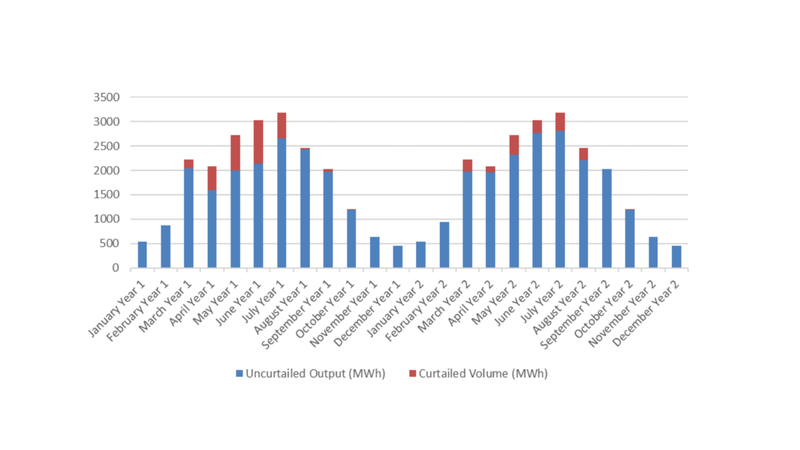
Sample Curtailment Study. May not be used without written permission from MEPPI's DSD team.
Curtailment Assessment Under Flexible Interconnections
In the UK, the high penetration of DER at distribution has pushed system operators to implement flexible interconnections for more than a decade. To ensure that site operators and stakeholders understand how the site will perform under a flexible interconnection, MEPPI offers in-depth time-series assessments. Our methodology is to build a comprehensive model of the system which forecasts, as best as possible, the actual curtailment (reduction in generation) that a flexibly interconnected site may face in any given half hour. This comprehensive model consists of
- A register of generation on the system
From these inputs, an AC load flow is run for every timestep (e.g. 1 hour period) in a year. Following the specified flexible interconnection control scheme, the system capacity for generation is determined alongside the necessary curtailment. This year-long picture provides insight into daily as well as seasonal trends that affect any restriction that a site sees.
Assumptions During Curtailment Analysis
As with any simulation, the model involves making certain assumptions – such expected production of renewable resources, attrition on the generation queue, or how load will evolve over time. MEPPI takes care to ensure that each assumption made is grounded in a conservative and reasonable estimate based on data and experience. In addition, we typically perform the above assessment under a variety of scenarios to provide a more complete understanding. This helps to identify the sensitivity of the site to ways in which the grid may change, as well as providing greater certainty in quantifying the site risk. This detailed output is composed into a report which provides developers with clarity to their site’s expected operation.
Long-term Curtailment Analysis
MEPPI has conducted this kind of analysis for the past decade for generation sources of all types – BESS, Wind, PV, and hybrid sites. As the landscape continues to evolve, we have started offering longer-term analysis that incorporates a wider timeline. These 10-year assessments consider anticipated changes in load, generation, and underlying network connectivity. This kind of analysis gives the best possible view into how a system will see its operation change over time.
Transmission-level Curtailment Analysis
As more DERs are connected at a transmission level, transmission operators are beginning to offer non-firm connections as well. In the UK, the National Energy System Operator (NESO) recently began offering non-firm connections at the transmission level.
While the basic premise for this study remains the same as at distribution, the system model becomes much more complex. In contrast to the distribution interconnections, the transmission system has no infinite source bus to draw from. So, the entire system must be dispatched balancing load and generation. To study the transmission system, we must incorporate the dispatch mechanism that determines what generators will produce during each timestep. Essentially, we must model the market that determines these setpoints.
MEPPI performs this analysis by implementing an optimal power flow (OPF). OPF optimizes a power system according to selected characteristics, while ensuring that the system is kept within identified limits (e.g., line ratings, generation bounds). In this case, we minimize the cost of dispatch, where the costs for each generator are set based on the expense of each generation type. While a full AC OPF incorporates reactive power, it is a nonconvex and nonlinear problem which does not scale well either in time or in network complexity. We have instead utilized a DC OPF, which makes several key assumptions to linearize the AC OPF and outputs real power dispatch throughout the system.
Including this market dispatch mechanism, the transmission curtailment assessment takes the following inputs:
- Loads are set at the interface between the transmission system and distribution system
- Generation at the transmission level is dispatched according to the DC OPF
This process is detailed further in the paper that MEPPI’s Senior Digital Solution Consultant, Kevin Dunn presented at the CIGRE Grid of the Future Conference this November*. This paper provides case study examples demonstrating scenarios when network constraints would cause non-firm connections to be curtailed. This type of study can also take outages into account to model non-intact scenarios.
Final Thoughts
Flexible interconnections are a key tool in today's power system, enabling new resources to connect to the grid quickly while avoiding expensive infrastructure upgrades. However, generation project developers need to understand the realistic operation and return on investment they can expect once they interconnect in a flexible manner. Forecasting and analytical risk assessment are an important bridge between a compelling offer and a sound business case. MEPPI continues to innovate on these well-tested methodologies to ensure that the developers and operators have access to the best possible operations forecasts and can understand the full context of their projects.
Learn more about our DERMS Advisory Consulting & Program Management services visit: https://www.meppi.com/dsd/consultancy-services
*Kevin Dunn, Mark Collins, Gustavo De Gois Himeno, “Case studies on curtailment assessment for grid-scale storage considering forecasted transmission constraints in the UK,” in *Proceedings of the CIGRE Grid of the Future Conference 2025*, [Denver, CO], [United States of America], 2025.