
 Industries
 Products
 Services
 Solutions
Blog | Quantifying Flexible Interconnection
Flexible interconnection is a type of grid connection that allows resources to connect to the distribution grid faster by accepting some level of system restriction rather than waiting and/or paying for system upgrades. This began with distributed generation such as wind, solar and battery energy storage systems, but is increasingly relevant for load connections such as data centers.
As flexible interconnection gains traction as a strategy for connecting new distribution-level resources (particularly in the regions of California, Colorado, Illinois, and the Northeast US), developers are asking important questions: What does flexibility really mean? And how often might a site be curtailed under this approach?
When a new site seeks to connect to the grid, system impact and feasibility studies are performed to confirm that the site can operate without negatively affecting existing grid operations. If approved, the facility is allowed to operate at full capacity.
Flexible interconnection introduces a different approach. Rather than limiting the number of new connections based on worst-case constraints, grid operators can manage potential impacts by temporarily curtailing a site's output when necessary to maintain safe and reliable grid operations. While this helps address grid concerns, it also raises an important question for developers: How will curtailment affect a site's production and revenue?
Answering that question requires a curtailment assessment. Developers often express concerns about the accuracy of forecasts under a flexible interconnection framework. Fortunately, flexible interconnection is a proven concept supported by mature modeling tools that can accurately quantify curtailment risk, estimate production impacts, and provide greater confidence in project performance.
Curtailment Assessment
At MEPPI, curtailment assessments are conducted using detailed power system models, forecasted operating conditions (e.g., load and generation) and defined operating principles (principle of access) to quantify the expected operational impact of flexible interconnection. The assessment is typically conducted for a study year and incorporates several core inputs:
- Power flow model of the grid
o This can be a full model of the grid, or for simple radial constraints, a linear model can be constructed.
- Forecast of loading profiles
o This typically uses historical load data and expected trends to project load for a particular future year.
- Model of generation
o A register of generation already connected and what is set to connect (including technology type).
o Meteorological data for the area to help determine renewable technology production profiles.
o Non-renewable production profiles are applied to other technologies including thermal generation and energy storage systems.
o The principles of access (PoA).
These components together inform the operational output of the flexible asset. At every time step, a calculation is made to determine the headroom at that moment (typically conducted at 30-minute or hourly resolution). This is done by performing a power flow calculation based on the model that incorporates:
Load flows throughout the utility network for that timestep and;
Generation production determined based by the applied technology profiles for that timestep.
If a thermal or voltage constraint is observed, flexible generation is curtailed in a priority defined by the principles of access (PoA). The PoA refers to the scheme the grid operator has employed for the flexible interconnection program. This most commonly refers to:
Last in First out (LIFO) wherein when there is a constraint exceedance on the system, generators are curtailed in a priority order with the last generator to connect curtailing fully before the next generator would be curtailed. Or;
Pro Rata wherein the generators in the scheme are curtailed collectively to relieve any constraint. This is most typically done as a percentage of registered capacity. For instance, to relieve a specific constraint, all generators may curtail 4% of their rated capacity in that timestep.
In the context of modeling, it is only relevant that the scheme is clearly defined. The simulations will implement whatever option the utility operator intends to employ.
In each modeled timestep, the curtailment for each flexible asset in the system is determined. The collective set is aggregated across the study period (typically a year) to determine an operational forecast. Flexible interconnection tends to employ generation which has significant seasonality, whether because it is meteorologically driven (solar or wind) or responding to seasonal use (Battery Energy Storage System - BESS). Correspondingly, the impact on a specific site is often concentrated to a particular season rather than across the full year. For instance, in Spring, solar peaks coincide with load that has not yet climbed to its summer high.
As an example, Figure 1 is a single-day study on a flexible solar site. For most of the day, there is no curtailment. As a result of other solar installations on the system, the midday solar peak for this site coincides with the low point in remaining headroom. This results in curtailment of the site during this peak.
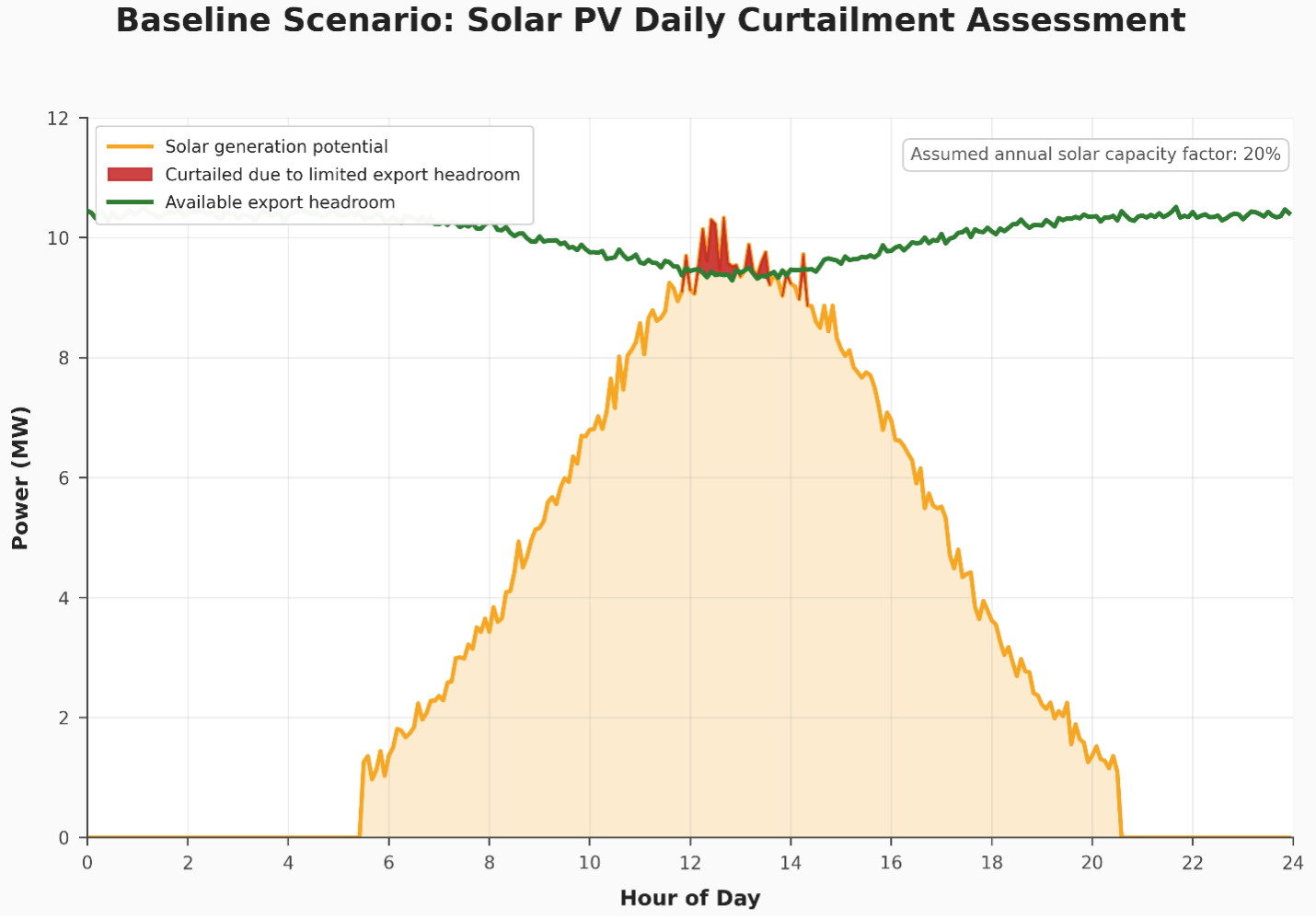
Figure 1
The curtailment assessment is carried out across the full year and can be broken down into monthly or time-of-day breakdowns. Outputs of the curtailment assessment include expected curtailment (useful for PV installations) or dispatch availability (useful for BESS seeking to bid into market). MEPPI provides a report that synthesizes all the necessary information to inform a decision, build a clear picture, and provide input for financial and investment decisions.
Robustness
These studies forecast operation. They are built on system understanding, but they are models including approximations whose inputs will also change over time. Stakeholders, depending on their context, will want to resolve these uncertainties in different directions. Curtailment assessments dispatched by utilities tend to be based on worst-case network long-term assumptions. When a single scenario is studied, it is common that assumptions are made conservatively. For example, when studying a site, the capacity factor for solar may be assumed to be slightly higher than expected in practice. A higher capacity factor in the model will correspond to a higher curtailment. While limits are configured for flexible interconnection to ensure that equipment is operated safely, some studies implement derating to ensure further conservatism.
Repeating the daily PV analysis as before but with these new assumptions results in higher curtailment, see Figure 2.
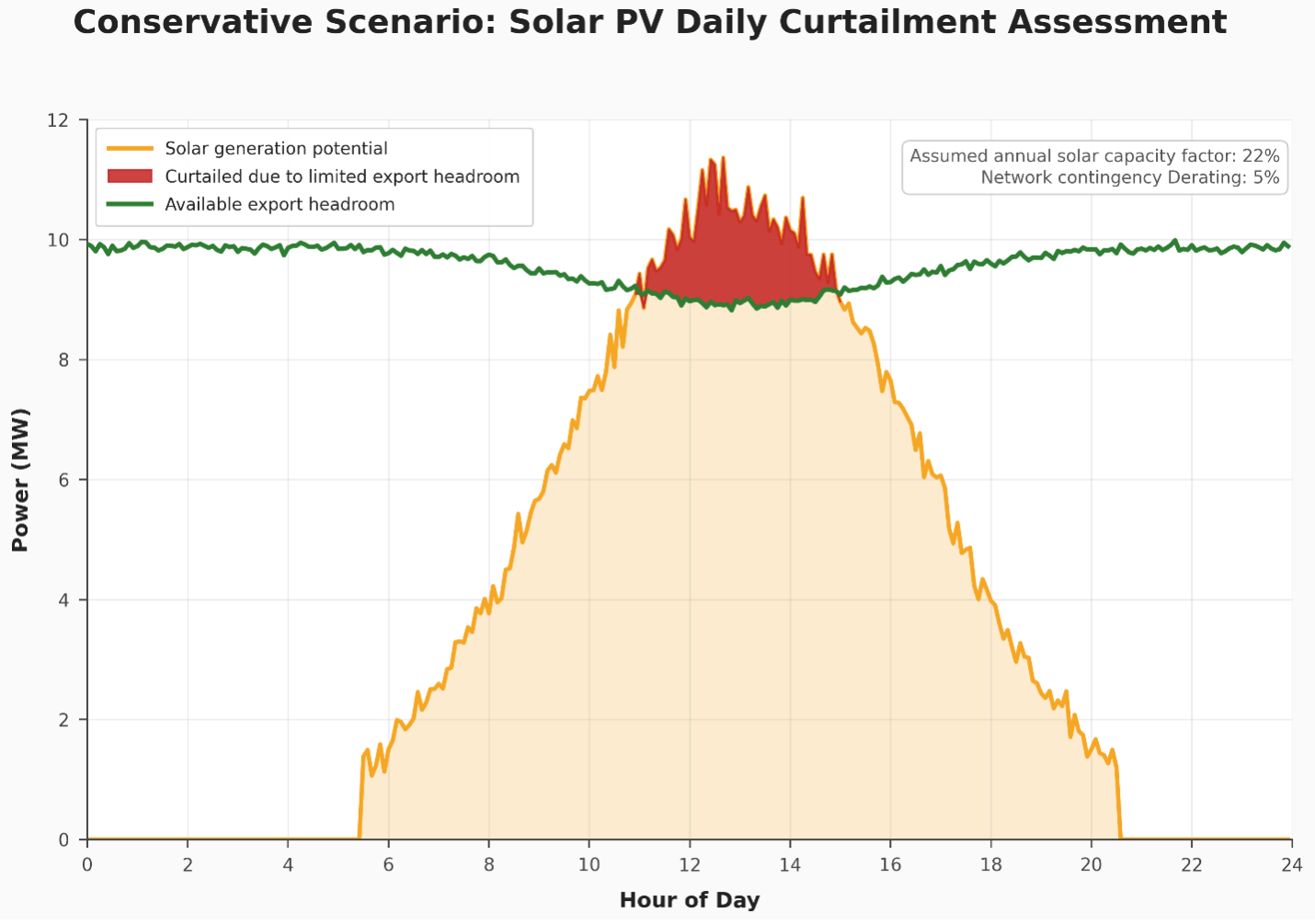
Figure 2
Rather than relying on a single set of assumptions to characterize expected system operation, MEPPI evaluates projects across multiple scenarios. These scenarios include a baseline, an optimistic case, and a conservative case, which follow specific and well understood assumptions. This provides a range of outcomes and quantifies the sensitivity of the system to specific factors, providing developers and investors with a clearer view of risk and opportunity.
Track Record
While flexible interconnection may still seem novel in parts of the United States, there are markets for flexible interconnection that are very developed. ERCOT, the independent system operator covering most of Texas, uses a “connect and manage” approach, but this is principally at a transmission level.
In the United Kingdom, flexible interconnection is a standard practice, even at a distribution level. Concerns about curtailment risk have been navigated by demonstrating an understanding of the accuracy of these curtailment methodologies and the sensitivity around assumptions applied to data inputs and study scenarios. Smarter Grid Solutions* alone controls over 1.8 GW of flexibly interconnected generation across Great Britain. Developers and financers have weighed the risk of curtailment against the cost impacts of energization timelines and reinforcement costs and have come down firmly in favor of flexible interconnection.
MEPPI has delivered flexible interconnection consultancy for over 15 years, studying more than 200 separate developments in the last 3 years alone for over 70 different developers. That track record has built trust in flexible interconnection as a practice, earned through rigorous attention to detail in every study. This sustained volume of repeat business speaks to the confidence developers and financers place in our work.
Flexible interconnection offers a powerful way to accelerate new generation connections faster and at a lower cost than waiting for full network reinforcement. However, its success depends on transparency and confidence for developers and financers into the expected site performance. By quantifying curtailment risk and operational impacts, curtailment assessments provide a common foundation for decision-making, helping developers, financiers, and utilities unlock capacity in even the most constrained parts of the grid.
* Smarter Grid Solutions Limited (SGS) is a subsidiary of Mitsubishi Electric Power Products, Inc. (MEPPI), a U.S. wholly owned subsidiary of Mitsubishi Electric Corporation.”