Flexible Interconnection: DERMS Solutions for Utilities

Increase Hosting Capacity Without Costly Grid Upgrades 

Unlock more capacity on your distribution network utilizing our flexible interconnection use case powered by MEPPI’s Strata Grid DERMS. Increase hosting capacity by 50–100%, accelerate DER interconnections, and defer millions in infrastructure investments—without waiting years for upgrades. 

Increase hosting capacity by 50–100% 
Reduce interconnection timelines by months or years 
Defer $Millions in grid upgrades 

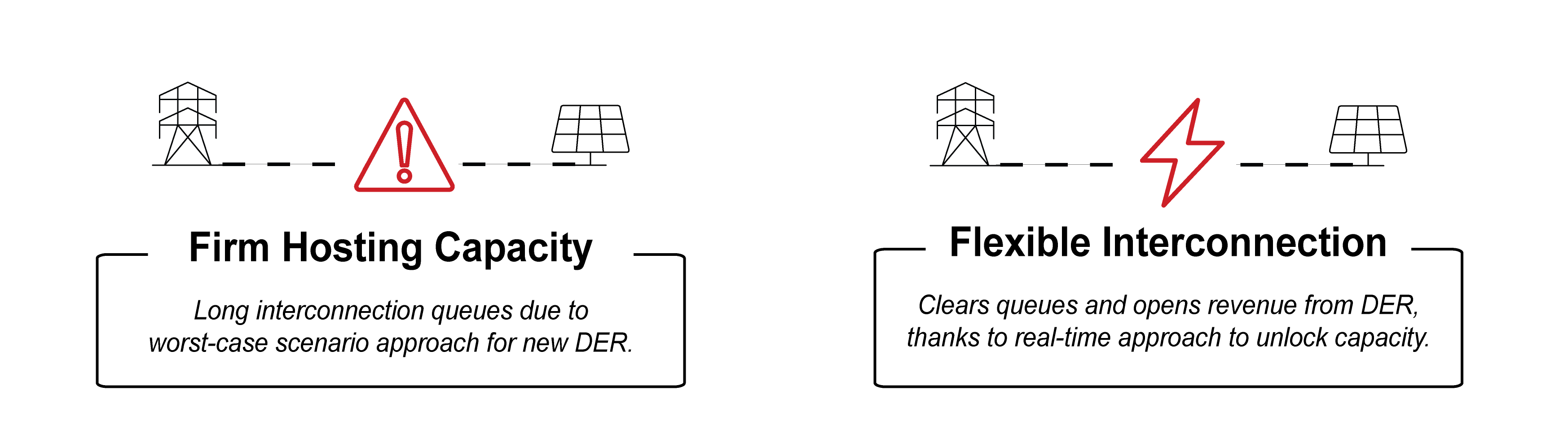
Firm Hosting Capacity vs. Flexible Interconnections

The Grid Capacity Challenge Facing Utilities 

Demand for distributed energy resources (DERs) and large loads like data centers is rapidly exceeding available hosting capacity across distribution networks. As a result, utilities are facing: 

  • Growing interconnection queues 
  • Increased curtailment 
  • Project delays and cancellations 
  • Rising infrastructure costs 
  • Extending equipment lead times 

Traditional solutions rely on major grid upgrades that can take months or years to complete and require significant capital investment. Meanwhile, developers and large-load customers are left waiting, delaying critical energy and business initiatives. 

Flexible interconnection provides a smarter, faster solution. 

Download Whitepaper "Flexible Interconnections: A tool to reduce grid connection timelines and increase renewable penetration"

What Is Flexible Interconnection? 

Flexible interconnection is a grid management approach that enables DERs to connect beyond traditional hosting capacity limits by using real-time monitoring and control. Instead of relying on fixed system assumptions, utilities dynamically manage DER output to avoid voltage, thermal, or system constraints, which unlocks capacity.

Figure 2: Fixed Hosting Capacity vs. Real-time Hosting Capacity (Fixed Hosting Capacity) vs. Flexible Interconnection.

Fixed Hosting Capacity vs. Real-time Hosting Capacity (Fixed Hosting Capacity) vs. Flexible Interconnection.

Key Concepts in Flexible Interconnection 

Understanding these core terms helps clarify how flexible interconnection works: 

  • Firm Hosting Capacity: The maximum DER capacity the grid can safely accommodate under conservative, worst-case assumptions (Avangrid). 
  • Flexible Hosting Capacity: Additional DER capacity that can be integrated using dynamic controls such as curtailment or export limits to prevent system violations (NREL). 
  • Flexible Interconnection (Non-Firm Interconnection): An approach that allows DERs to connect under managed conditions, where output may be adjusted in real time to maintain grid reliability (EPRI). 
  • Curtailment: The controlled reduction of DER output to ensure safe system operation and prevent overloads or instability (NREL). 

Concept Simple Framing Key Difference Why It Matters
Firm Hosting Capacity Grid capacity with no intervention Always available Defines baseline limits
Flexible Hosting Capacity Capacity with active management Conditional Expands usable grid capacity
Flexible Interconnection Connection method using controls Enables flexibility Avoids upgrades, speeds interconnection
Curtailment Output reduction when needed Real-time action Maintains reliability

Why Flexible Interconnection Matters Now 

Utilities today must balance three competing priorities: 

  • Speed: Connecting DERs and large loads faster 
  • Cost: Avoiding expensive infrastructure projects that trigger increases for ratepayers 
  • Reliability: Maintaining stable grid operations 

 Flexible interconnection addresses all three by: 

  • Unlocking unused grid capacity 
  • Reducing dependence on long upgrade cycles 
  • Enabling real-time grid optimization 

How MEPPI Enables Flexible Interconnection 

MEPPI’s Strata Grid DERMS delivers a proven, scalable approach to flexible interconnection. 

1. Real-Time Grid and DER Control 

Strata Grid leverages patented real-time algorithms to continuously monitor grid conditions and DER performance, applying fast, autonomous control actions to maintain safe operating limits. It applies threshold-based corrective control to dynamically adjust DER export or import set-points, ensuring local grid assets operate safely within their limits. 

2. Model-Free Architecture for Faster Deployment 

Unlike other DERMS platforms, Strata Grid does not rely on a network model. This significantly reduces: 

  • Deployment time 
  • Implementation complexity 
  • Upfront cost 

Utilities no longer need to wait for perfect data sets to achieve DER value. 

3. Targeted, Scalable Grid Relief 

Strata Grid’s model-free architecture also supports targeted deployments, allowing utilities to address specific network constraints. Solutions can scale over time as demand grows. 

Case Study: Avangrid (FICS)

Problem

Avangrid was receiving customer feedback related to the high cost and timescale of DER interconnection being driven by the need for grid upgrades.

Solution

Using Strata Grid, Avangrid introduced flexible interconnection methods. Customer interconnection agreements were amended to incorporate the fast-acting, autonomous control methods used by Strata Grid to minimize curtailment actions.

Result

The project demonstrated the capability of Strata Grid to double grid hosting capacity and reduce customer need for capital expenditure.

Copyright © 2024 Mitsubishi Electric Power Products, Inc. All Rights Reserved. Privacy Policy